This machine was a cool find. I have fond memories of bowling as a kid. I had a Big Brother from the Big Brother's/Big Sisters program named Richard who used to take me bowling. I love the center rollovers of this game that represent the pins. I love the idea of strikes and spares. The organization of the bottom is unique and quite fun. This machine is a great example of 1960s pinball at it's best. The artwork is Corny/Cool. The colors work well together, and the game played well.
I replaced the backglass with a plexi replacement. It looks wonderful. The old one had way too much paint loss to salvage.
The game had a bell in the back box instead of chimes.
The balls drop down into a ball trough in the cabinet. There are tunnels under the playfield where the balls can drop through the "Gobble Holes". With this vintage machine, you could play all five balls at once if you wanted to. You can lift then plunge balls at your own pace. The trough releases all of the balls down to you when you start the game (like a Skee Ball machine).
This is the coin door. The cabinet was pretty worn, but the original paint is pretty desirable by collectors. I would have preferred to repaint it myself if I kept it. The silver button on the left is the start button. The coil slots are horizontal instead of vertical with a flatter arrangement inside the coin door. Underneath the plunger is the lift rod (it is missing the knob). You push on this rod to manually lift a ball into the shooter lane.
Here is the inside of the cabinet with the score motor and relays.
Here is the underside of the playfield where you can see the silver tunnels that the ball travels through when it exits through the "Gobble Holes" on the playfield to return to the ball trough. When a ball goes through the "Gobble Hole", you lose the ball, but score points.
Towards the top of the picture you can see a nearly horizontal oval. This is a window to look down into the ball trough which tells you how many balls you have left.
Here is the playfield. The holes on the outside of the pins are the "Gobble Holes" and have a flap to ease the ball down into the tunnel under the playfield.
In the left of the apron you can see the hole that allows you to see the balls in the trough. if the sides of the border around the hole are highly polished, you get a reflection like a mirror of the balls. You can see this a bit in the picture.
The cabinet art is pretty basic and doesn't really reflect the bowling theme.
This machine came with its original paperwork, always a cool find.
If you look closely at the instruction card in the above picture, the game is designed around the award of a replay. Everything you are shooting for in the game is less based on points or free balls. When they designed this machine, a replay was a very cool reward for scoring features on a game. Williams probably never expected these games to survive this long or to eventually become part of a home collection. When you own the machine and put the machine on "free play", a replay is not very exciting. If the game could have been adjusted to score extra balls or points for specials, I would still own this game. However, when a game is so focused on replays, it can get old quickly in a collection. If I ever own one of these again, I will probably try to redesign some of the relays to make it an "add a ball" game.
Repair and Sales in Colorado serving Canon City, Pueblo, Pueblo West, Salida, Florence, Fremont County, and Colorado Springs
Saturday, July 14, 2018
Friday, July 13, 2018
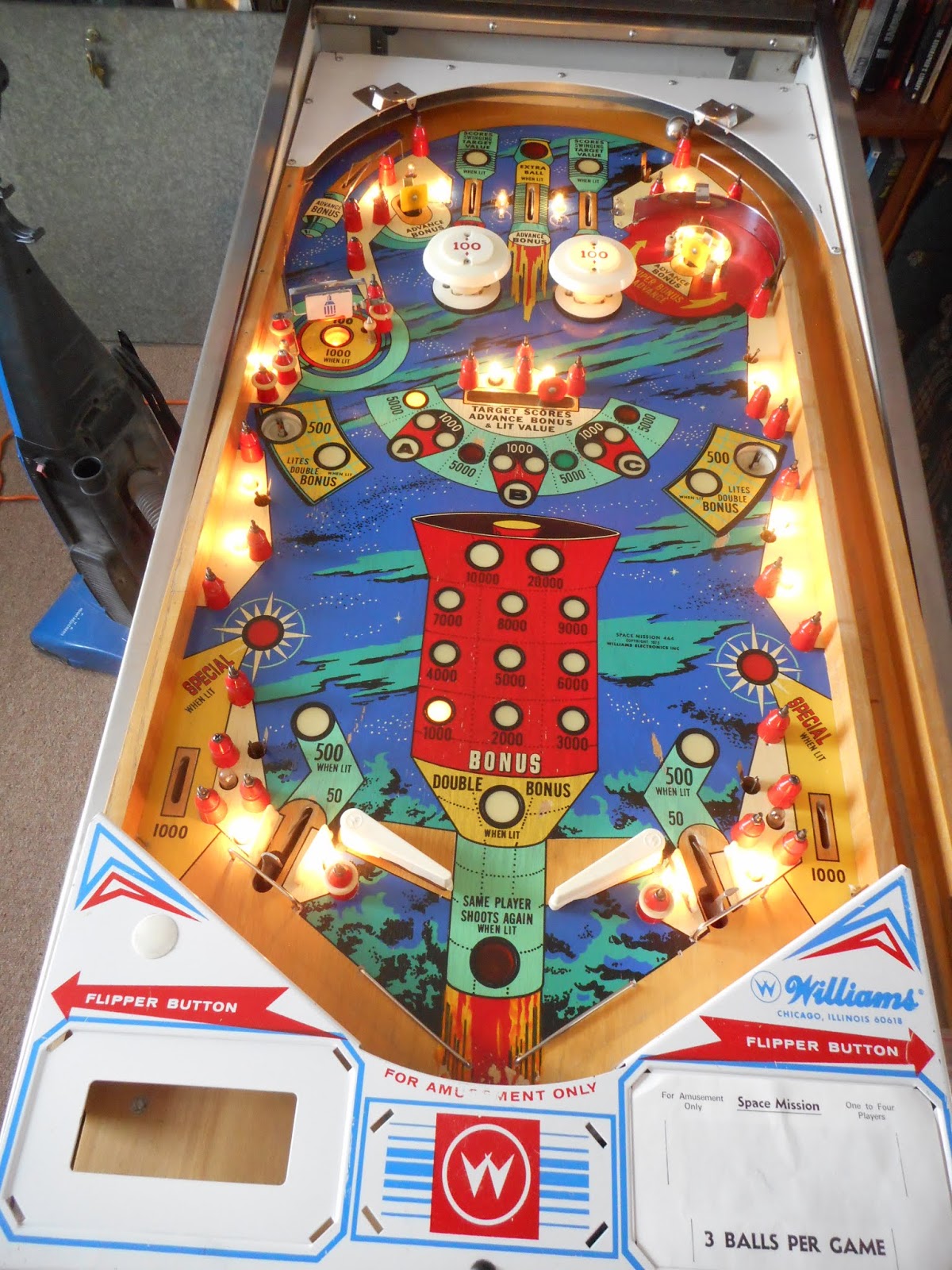
1976 Williams Space Mission Pinball Machine - Sold
I bought this Space Mission for myself. I love space themed games. I'm not sure why as I was never really interested in space travel, science fiction, or the space race.
Anyway, this one looked cool. Didn't work. Long story short, put in a lot of time and came to the realization that I didn't like the kick out holes instead of sling shots on this game. Again, I considered altering the bottom of the playfield, then changed my mind and let it go. Very cool artwork and great design. Played great, just wasn't a fan of those holes.
Thursday, July 12, 2018
1980 Bally Space Invaders PInball Machine - Sold
I purchased this one for my personal collection. Great artwork. I really enjoyed the game, but eventually became frustrated by the lack of purpose of the left side of the playfield. It was a drain waiting to happen and there weren't enough points to justify shooting the ball over there. I went back and forth. I decided I'd add a ramp to replace the traveling ball/clone chamber section with a habitrail that looped back to the right flipper. I bought the parts, then decided it was just time to move on. Perhaps something I'll do another time.
The rectifier board was a mess. It had a few hacks that kept it working, but it really needed to be replaced. I put in a Rottendog board.
I also had to repin the connectors.
It worked well and was fun while it lasted. Still probably the best artwork out there. Very cool backglass.
The rectifier board was a mess. It had a few hacks that kept it working, but it really needed to be replaced. I put in a Rottendog board.
I also had to repin the connectors.
It worked well and was fun while it lasted. Still probably the best artwork out there. Very cool backglass.
Wednesday, July 11, 2018
1985 Williams Sorcerer Pinball Machine - Sold
I have a knack for finding the most mistreated dirty machines. This one was buried in a guys workshop. The playfield glass had broken and the millions of tiny cubes of glass were scattered everywhere. All of the dust and dirt and smoke from his workshop made this machine quite a mess.
These pictures represent how dirty it was after the extensive vacuuming of the playfield and cabinet.
The biggest issues with the machine were that the ball wouldn't kick out of the ramp lock and the drow targets wouldn't reset. The owner had tried to fix them unsuccessfully. I wish I had taken a picture of it but he used a small "C" clamp and a length of angle iron to stop the drop targets from dropping so the game could still be played without them.
I went through the boards and replaced the transistors that should have been causing the issues. No luck. I worked on it for a couple of months off and on and finally gave up and sent it to a board repair expert. It came back looking pretty with a new NVRAM to eliminate the batteries, but still didn't work. Everything tested on his bench like it did for me. Finally I added a small wire to bridge the ground connection to the transistors and "Magic" it worked again.
The machine cleaned up pretty well and played great. I played it for about a year before I decided it was time to move it on.
This picture shows a chunk of missing paing and inserts that have raised and then been chipped away by balls on their edges. The correct fix would have been replacing almost all of the inserts and repainting the damaged sections. This game wasn't worth that to me, so I sold it.
These pictures represent how dirty it was after the extensive vacuuming of the playfield and cabinet.
The biggest issues with the machine were that the ball wouldn't kick out of the ramp lock and the drow targets wouldn't reset. The owner had tried to fix them unsuccessfully. I wish I had taken a picture of it but he used a small "C" clamp and a length of angle iron to stop the drop targets from dropping so the game could still be played without them.
I went through the boards and replaced the transistors that should have been causing the issues. No luck. I worked on it for a couple of months off and on and finally gave up and sent it to a board repair expert. It came back looking pretty with a new NVRAM to eliminate the batteries, but still didn't work. Everything tested on his bench like it did for me. Finally I added a small wire to bridge the ground connection to the transistors and "Magic" it worked again.
The machine cleaned up pretty well and played great. I played it for about a year before I decided it was time to move it on.
This picture shows a chunk of missing paing and inserts that have raised and then been chipped away by balls on their edges. The correct fix would have been replacing almost all of the inserts and repainting the damaged sections. This game wasn't worth that to me, so I sold it.
Subscribe to:
Posts (Atom)